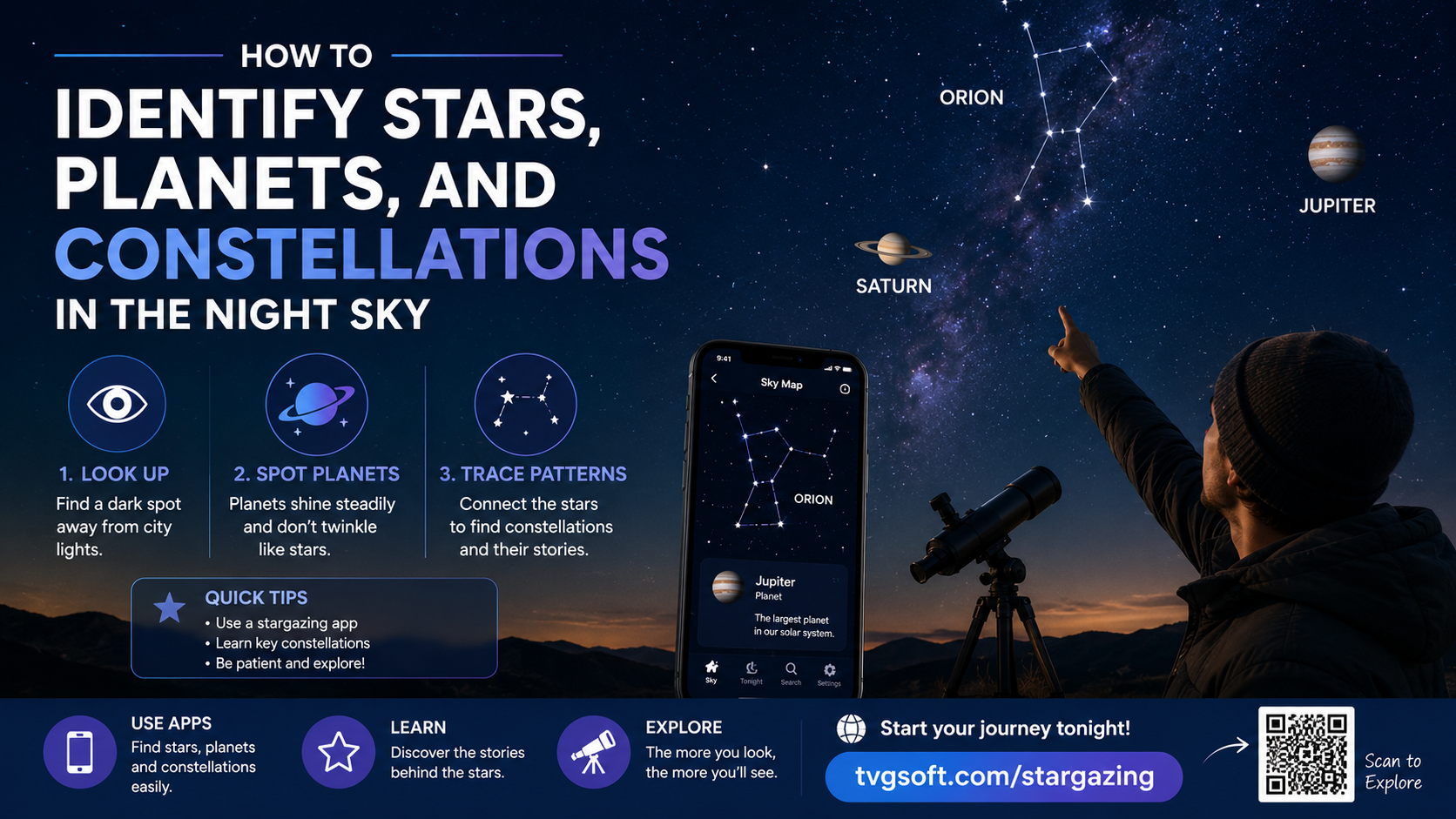
How to Identify Stars, Planets, and Constellations in the Night Sky
Look up on any clear night and you'll see hundreds of points of light scattered across the darkness. A handful are planets. Most are stars, many of them grouped into constellations that different cultures have named and mapped for thousands of years. For beginners, that view can feel overwhelming but with the right approach, and the right tool, decoding the sky becomes one of the most rewarding hobbies you can pick up, and it costs nothing to start.
This guide walks through how modern stargazers actually identify what's overhead, why a live, location aware sky map has become the go-to method, and how to get the most out of a single night under the stars.
Why the Night Sky Feels Confusing at First
Unlike a map of your city, the sky doesn't stay still. Stars rise and set. Planets drift slowly against the background of fixed stars over weeks and months. Constellations shift position depending on the season, your location on Earth, and even the exact time of night. A star chart printed for January won't line up correctly in July, and a diagram made for New York won't match the sky over Tokyo or Sydney.
That's the core challenge: the night sky is a moving, location dependent picture, not a static one. Any tool or method you use for identification has to account for your exact date, time, and geographic coordinates to be accurate.
The Traditional Approach: Star Charts and Memorization
Before smartphones, stargazers relied on printed planispheres, rotating star wheels, and memorized reference points like the Big Dipper or Orion's Belt. This method still works and builds genuine skill many experienced amateur astronomers can point to a dozen constellations without any device at all.
The drawback is the learning curve. Matching a two dimensional paper chart to a three dimensional sky, correcting for your orientation, and accounting for atmospheric distortion near the horizon all take practice. For a first timer standing outside at 9 p.m. wondering what that bright object near the Moon is, a printed chart rarely gives an instant answer.
The Modern Approach: Real-Time, Point and Identify Sky Maps
This is where dedicated stargazing apps have changed the experience entirely. Instead of cross-referencing a chart, you simply raise your phone toward the sky, and an augmented, real-time star map overlays names and outlines directly onto what you're looking at. The app uses your device's location, compass, and the current date and time to calculate exactly which stars, planets, and constellations should be visible from where you're standing at that exact moment.
A well-built sky map app typically offers:
- Real-time identification of stars, planets, and the Moon for any date, time, and location on Earth
- A deep-sky catalog covering nebulae, galaxies, and star clusters, viewable with detailed zoom
- Multiple constellation art styles, including line patterns and artwork drawn from different sky traditions and cultures around the world
- Satellite tracking, so you can follow objects like the International Space Station as they pass overhead
- A 3D solar system model for inspecting planets and their major moons up close
- Offline functionality and a night mode, using a red-tinted display that protects your eyes' dark adaptation while working without an internet connection
This combination turns a confusing sky into a labeled, explorable map no prior astronomy knowledge required.
Tips for a Better Stargazing Session
Whether you're using an app, a paper chart, or your own memory, a few habits make a noticeable difference:
- Get away from bright lights. Light pollution from cities washes out fainter stars. Even a short drive to a darker area dramatically improves visibility.
- Let your eyes adjust. It takes about 20–30 minutes for your eyes to fully adapt to darkness. Avoid looking at bright screens during this window or use a night mode with a red-tinted display instead.
- Check the Moon phase. A full moon brightens the whole sky and can hide fainter objects. A new moon or crescent phase gives you the darkest, most detailed view.
- Start with something bright. Planets like Venus, Jupiter, and Mars are often the easiest and most satisfying objects to identify first, since they don't twinkle the way stars do.
- Track the ISS. The International Space Station is visible to the naked eye during certain overhead passes and moves noticeably faster than any star or planet a great way to introduce satellite tracking to beginners.
Bringing It All Together with Stargazing: Stars & Planets
If you'd rather skip the trial and error, the Stargazing: Stars & Planets app packages everything above into a single free tool for iOS and Android. Point your phone at the sky and it names every star, planet, and constellation above you in real time, complete with a deep-sky catalog, switchable constellation artwork from sky traditions around the world, live satellite tracking, a detailed 3D solar system, and an offline, night-mode-friendly design that keeps your night vision intact. It currently holds a 4.4-star rating from tens of thousands of downloads, and the compact dataset means it keeps working even without a signal — ideal for stargazing away from cell coverage.
Start Exploring the Sky Tonight
You don't need a telescope, a science degree, or a perfectly dark backyard to start recognizing what's above you — just a clear patch of sky and a tool that can translate it in real time. Download Stargazing: Stars & Planets free on the App Store or Google Play, step outside tonight, and hold the whole sky in the palm of your hand.